
ROXAS CITY, Capiz – Entrepreneurship is not simply about making money. It is about creating opportunities, generating jobs, solving problems, strengthening communities, and building something meaningful enough to outlive its founders. This was the central message of Jose Nery “Bub” Ong, President and CEO of Pueblo de Panay, Inc., during the Western Visayas Business Conference and Expo (WV BizConEx) on Wheels – Capiz Leg, held on July 29, 2026, at San Antonio Resort in Baybay, Roxas City, Capiz.
Speaking before entrepreneurs, government leaders, MSME advocates, and members of the Western Visayas business community, Ong drew from more than three decades of entrepreneurial experience to share lessons on risk, financial discipline, integrity, continuous learning, resilience, community building, and finding a deeper purpose in business. Rather than presenting entrepreneurship as a pursuit of profit alone, Ong described it as a mission. For him, businesses have the potential to create value not only for their owners but also for employees, families, communities, and future generations.
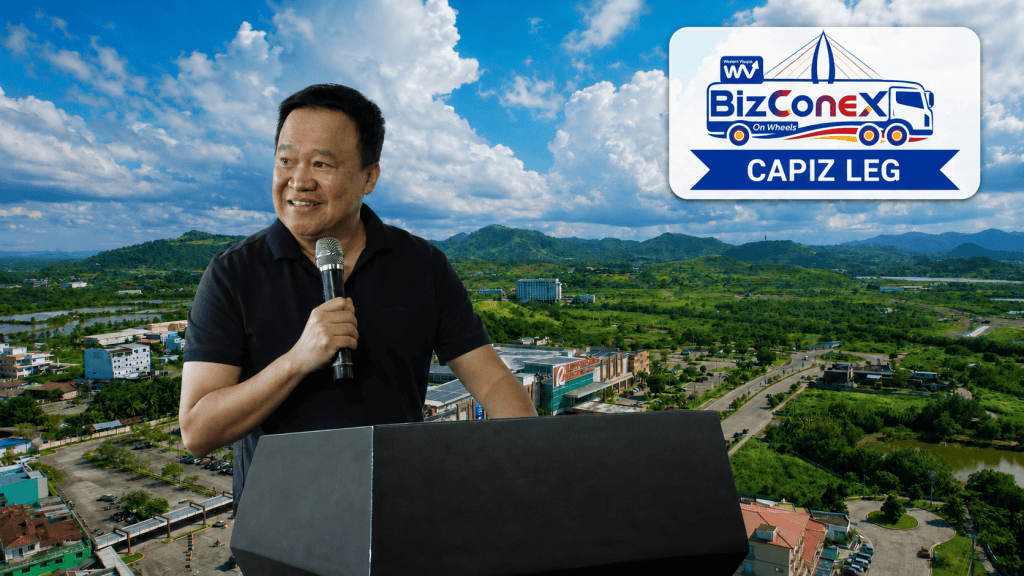
Ong traced this philosophy back to the early years of his entrepreneurial journey. After graduating from college in 1992, he entered adulthood at a time of considerable economic and social uncertainty in the Philippines. Many young professionals from his generation were looking overseas for better opportunities, and several of his own college friends eventually chose that path.
Ong decided to stay.
Instead of seeing the difficult business environment solely as a disadvantage, he began asking whether opportunities could still be created at home. He observed that successful entrepreneurs could emerge even from places facing significant economic challenges. That realization strengthened his belief that while location and circumstances matter, the mindset and actions of the entrepreneur can make an equally important difference.
“Entrepreneurs don’t look at things as threats. They always see opportunities,” Ong told the audience. “They don’t dwell on problems. They look at problems as challenges to be solved.”
That mindset helped shape the business he eventually built with his siblings. Starting with limited capital, they entered housing development and experienced firsthand the realities faced by many young enterprises. The first years were largely about survival, requiring discipline, careful management, and constant attention to cash flow.
For Ong, this remains one of the most practical lessons for entrepreneurs and MSMEs today. A company may appear profitable on paper and still encounter difficulties if it lacks liquidity. Business owners therefore need to understand where their cash is, where it is going, and whether the enterprise is still being subsidized by its owners, has reached break-even, or is already generating sustainable returns.
His message to MSMEs was straightforward: know your numbers.
But financial discipline, Ong emphasized, is only one part of building a sustainable enterprise. Equally important is the reputation of the person behind it.
“The entrepreneur is the brand,” he said.
For Ong, branding begins long before logos, advertisements, or marketing campaigns. It is reflected in whether entrepreneurs honor their commitments, arrive on time, keep their word, and earn the trust of the people they work with. An entrepreneur’s character ultimately becomes intertwined with the reputation of the business.
This belief places integrity at the center of entrepreneurship. Customers, employees, suppliers, partners, and communities do not simply evaluate what a company sells. They also observe the people leading it. Credibility, consistency, and professionalism therefore become business assets that can take years to build and only moments to damage.
Ong also stressed that entrepreneurs cannot afford to stop learning. His own experience during the 1997 Asian Financial Crisis became an important turning point. Until then, the family enterprise had been operating successfully largely through experience and practical judgment. The crisis made him recognize the importance of complementing those instincts with formal business knowledge, theories, and strategic frameworks.
He eventually pursued and completed an MBA, but he emphasized that education should never be reduced to earning diplomas or certifications. The purpose of studying, he said, is to learn, and the purpose of learning is to apply knowledge to real problems.
That philosophy continues to guide him decades later. Even after more than 35 years in entrepreneurship, Ong continues learning about emerging subjects including artificial intelligence, cybersecurity, and geopolitics. In a rapidly changing business environment, he believes curiosity and lifelong learning are essential to remaining relevant.
One of the most consequential decisions in the Ong family’s entrepreneurial journey came when the business had grown enough to consider its next direction. They faced two possible paths: expand their housing developments to other parts of the Philippines or concentrate their resources and invest more deeply in Capiz.
Both options offered potential financial returns.
The family chose Capiz.
Instead of growing wider, they decided to grow deeper in their hometown. That long-term commitment would eventually contribute to the development of Pueblo de Panay Township in Roxas City, reflecting the family’s belief that a homegrown, countryside-based enterprise could pursue world-class aspirations while remaining deeply rooted in its community.
For Ong, township development represented an entirely different level of responsibility. Unlike individual housing developments, building a township requires decades of planning, investment, patience, and stewardship. He acknowledged that its magnitude ultimately makes it a lifetime commitment and that its long-term sustainability will depend on succeeding generations.
This perspective raises an important question for entrepreneurs and family businesses: Will the enterprise survive beyond its founders?
Succession, for Ong, is therefore not simply about transferring ownership. It is about building an institution strong enough to continue its mission even after the generation that started it is gone.
His understanding of that mission became even more personal following the deaths of his parents. Their passing forced the family to reflect on fundamental questions about the purpose of their work: What truly matters? Why continue building? What responsibility does a business have to the people around it?
From those reflections emerged a deeper commitment to family, employees, and the communities in which they operate.
“Our mission is to be a meaningful catalyst and a source of pride in the communities that we do business in,” Ong shared.
That mission also reflects the philosophy behind Pueblo de Panay. For Ong, developing businesses in Capiz is not simply about generating financial returns. It is about demonstrating that a homegrown company based in the Philippine countryside can aspire to world-class standards while creating opportunities closer to home.
He encouraged fellow entrepreneurs to take the time to define their own mission because there will inevitably be moments when business becomes difficult. Markets change. Plans fail. Investments do not always produce the expected results. During those moments, entrepreneurs need something deeper than financial motivation to keep moving forward.
“When things don’t go your way, you need to go back to your reason why,” he said.
Failure, Ong added, is unavoidable in entrepreneurship. Decades of experience may improve a leader’s judgment, but they can never completely eliminate the possibility of making a wrong decision.
What matters is how entrepreneurs respond.
Ong believes failure should become an opportunity to learn and improve. As he tells his children, failure is not necessarily a mistake when someone has genuinely done their best and learned from the experience. At the same time, he emphasized that effort remains non-negotiable. Successful entrepreneurship demands hard work, commitment, and a willingness to take calculated risks.
Decision-making is equally important. Entrepreneurs rarely have the luxury of waiting for perfect information, and there is often no perfect decision available. There is only the best decision that can be made under the circumstances.
Indecision, he warned, also has a cost.
His advice is to make calculated and timely decisions, learn from the outcome, and adjust when necessary.
As industries face another period of significant disruption, particularly with the rapid development of artificial intelligence, Ong believes entrepreneurs should apply the same opportunity-oriented mindset.
Instead of viewing AI purely as a threat, entrepreneurs should ask what possibilities it creates. Technologies change, industries evolve, and new challenges emerge, but the fundamental role of the entrepreneur remains the same: identify problems and build solutions.
That role becomes even more significant in places where economic opportunities are still needed.
Ong described entrepreneurship as one of society’s greatest sources of wealth creation. For communities across Capiz and Western Visayas, stronger businesses and MSMEs can mean more jobs, more livelihoods, greater economic activity, and more opportunities for families.
This is why entrepreneurship, in his view, is ultimately a mission worth pursuing.
“The world is full of problems,” Ong said as he concluded his message. “As long as there are problems to be solved, the world will always be in need of entrepreneurs.”
For the entrepreneurs and MSMEs gathered at the Western Visayas Business Conference and Expo (WV BizConEx) on Wheels – Capiz Leg, his message offered a definition of business success that extends far beyond the balance sheet.
Profit allows an enterprise to survive. Discipline allows it to grow. Integrity earns trust. Learning keeps it relevant. Resilience carries it through difficult times.
But purpose determines what all that success is ultimately for.
For Jose Nery “Bub” Ong, the entrepreneurial journey is not simply about building successful companies. It is about creating opportunities, developing communities, investing in places like Roxas City and Capiz, and building institutions that future generations can continue.
Because a successful business can create wealth.
A purposeful business can leave a legacy.